
Lahore Prayer Time Maghrib Today Sunset Prayer Time in Lahore
Maghrib is the fourth prayer of the day. It is one of the five obligatory prayers in Islam. Every Muslim must pray it daily without fail. It is prayed right after sunset. In Lahore, Maghrib prayer time today is around 7:25 PM for June 2026. This timing changes every month so it is always good to check a reliable source daily.
Maghrib starts the moment the sun fully sets below the horizon. It does not have a long window like other prayers. You have roughly 60 to 90 minutes to pray it before the time ends. This short window makes Maghrib one of the most important prayers to prepare for in advance. Do not delay it. Pray it as soon as you hear the Azan.
What Is Maghrib Prayer?
Maghrib means sunset in Arabic. It is the fourth prayer of the five daily prayers in Islam. You pray it right after the sun goes down. It comes after Asr and before Isha. This prayer marks the end of the day and the beginning of the evening.
Maghrib is one of the shorter prayers in terms of rakats. But do not let that fool you. It carries great importance in Islam. The Prophet Muhammad (Peace Be Upon Him) always prayed Maghrib on time without delay. He never postponed it even when he was tired or busy.
How Many Rakats Are in Maghrib?
Maghrib has a total of 7 rakats when you include all the Sunnah and Nafl prayers.
| Type | Rakats |
|---|---|
| Sunnah Muakkadah (before Fard) | 0 |
| Fard | 3 |
| Sunnah Muakkadah (after Fard) | 2 |
| Nafl (optional) | 2 |
| Total | 7 |
The 3 Fard rakats are obligatory. Every Muslim must pray them. The 2 Sunnah rakats after Fard are strongly recommended. The Prophet (Peace Be Upon Him) regularly prayed them. The 2 Nafl rakats are optional but carry extra reward.
Why Is Maghrib Prayer Important?
Maghrib is important for many reasons. First it is a Fard prayer. Skipping it without a valid reason is a serious matter in Islam. Second it has the shortest prayer window of all five daily prayers. This teaches Muslims to be alert and not lazy about worship.
Maghrib also marks a special time of day. The transition from daylight to darkness is a moment Allah has chosen for this prayer. Standing before Allah at this exact moment carries a spiritual weight that is hard to put into words. It is your daily checkpoint between the day you lived and the night ahead. It is a moment to be grateful, to reflect, and to reconnect.
Here is the section:
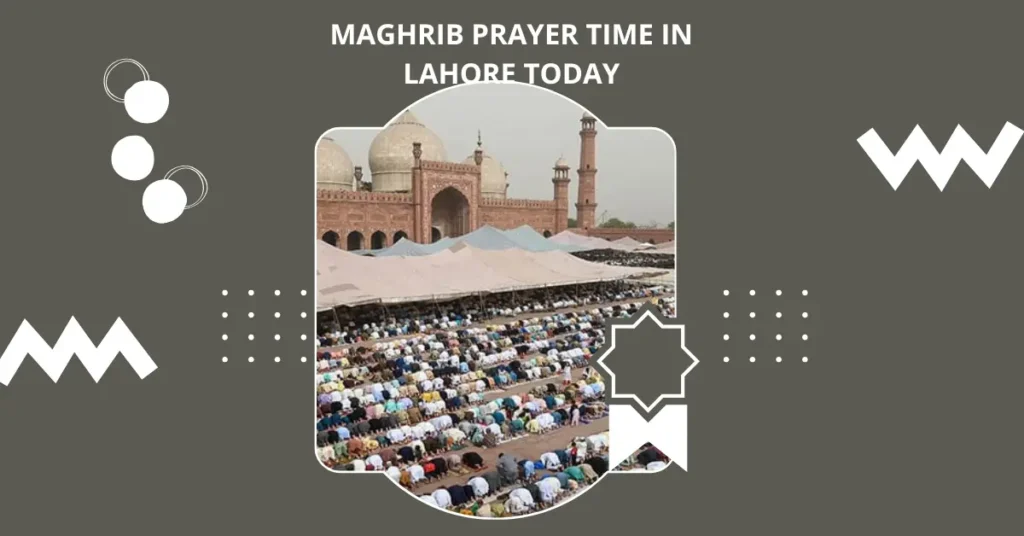
Maghrib Prayer Time in Lahore Today
Here are today’s prayer times for Lahore. These timings are based on the standard Hanafi calculation method used across Pakistan.
| Prayer | Time |
|---|---|
| Fajr | 3:50 AM |
| Sunrise | 5:20 AM |
| Dhuhr | 12:10 PM |
| Asr | 5:15 PM |
| Maghrib | 7:25 PM |
| Isha | 8:55 PM |
If you’re looking for a peaceful and historic place to offer your Maghrib prayer in Lahore, the Badshahi Mosque is one of the best options. This magnificent Mughal-era mosque welcomes thousands of worshippers daily, including at sunset for Maghrib prayer. To learn more about its history, architecture, and visitor details, check out our complete guide on Badshahi Mosque Lahore: Pakistan’s Most Famous Mughal Masterpiece – History, Architecture & Visitor Guide 2026.
When Does Maghrib Prayer Start?
Maghrib starts the moment the sun fully sets below the horizon. You do not need to wait for the Azan to finish. The moment the sun disappears the prayer time has entered. In Lahore this happens around 5:15 PM in winter and as late as 7:25 PM in summer. The timing shifts gradually every single day so always check before assuming.
One important thing to remember is that you do not need to see the sunset yourself. Simply follow the calculated time from a reliable prayer app or your local mosque. On cloudy or rainy days the sun may not be visible at all. The calculated time is what matters.
When Does Maghrib Prayer End?
Maghrib ends when the red twilight in the western sky completely disappears. This happens roughly 60 to 90 minutes after sunset. In simple terms if Maghrib starts at 7:25 PM it will end around 8:55 PM when Isha time enters.
This is the shortest prayer window among all five daily prayers. Other prayers give you several hours. Maghrib gives you barely one hour. This is why you should never delay it. Once that window closes you have missed the prayer in its time. Always treat Maghrib with urgency.
What Is the Best Time to Pray Maghrib?
The best time to pray Maghrib is as early as possible. Pray it right after sunset. Do not wait. The Prophet (Peace Be Upon Him) used to pray Maghrib so quickly after sunset that people barely had time to finish their arrows before the congregation was done.
In practical terms aim to pray Maghrib within the first 15 to 20 minutes after it starts. This keeps you well within the prayer window and follows the Sunnah of praying it early. Make it a habit to stop whatever you are doing when the Maghrib Azan sounds and go straight to prayer.
How Is Maghrib Time Calculated?
Maghrib is the simplest prayer to calculate among all five daily prayers. There are no angles to measure. No shadow lengths to check. Maghrib time is simply based on one thing. Sunset.
The moment the upper edge of the sun disappears below the western horizon Maghrib time enters. That is it. No complicated formula. Just sunset.
Based on Sunset
Astronomers calculate the exact second when the sun crosses the horizon line in Lahore. This is done using Lahore’s geographic coordinates. Lahore sits at 31.5 degrees North latitude and 74.3 degrees East longitude. These coordinates are fed into prayer time calculators and the result is your daily Maghrib time.
Unlike Fajr which depends on twilight angles or Asr which depends on shadow length Maghrib is directly tied to a visible natural event. This makes it the easiest prayer to understand and follow. When the sun goes down Maghrib begins. Simple as that.
Seasonal Variations
Maghrib time changes significantly between summer and winter in Lahore. Here is a simple monthly guide so you always know what to expect.
| Month | Sunset Time | Maghrib Time |
|---|---|---|
| January | 5:30 PM | 5:32 PM |
| February | 5:50 PM | 5:52 PM |
| March | 6:10 PM | 6:12 PM |
| April | 6:30 PM | 6:32 PM |
| May | 6:50 PM | 6:52 PM |
| June | 7:20 PM | 7:22 PM |
| July | 7:15 PM | 7:17 PM |
| August | 6:55 PM | 6:57 PM |
| September | 6:25 PM | 6:27 PM |
| October | 5:55 PM | 5:57 PM |
| November | 5:25 PM | 5:27 PM |
| December | 5:15 PM | 5:17 PM |
As you can see the difference between the earliest and latest Maghrib in Lahore is about 2 hours. In December Maghrib comes as early as 5:15 PM. In June it can be as late as 7:22 PM. This is a big shift and many people get caught off guard during seasonal transitions.
Why Do Timings Change Daily?
The Earth moves around the sun at a slight tilt. This tilt is what creates seasons. As the Earth moves throughout the year the angle of sunlight hitting Lahore changes. This directly affects how early or late the sun sets each day.
In summer the sun follows a longer arc across the sky. It rises earlier and sets later. In winter the arc is shorter. It rises later and sets earlier. This is why Maghrib in June feels late and Maghrib in December feels very early.
The change is gradual. Usually just 1 to 2 minutes per day. But over weeks and months that adds up to a big difference. This is why you should check prayer times regularly and not assume today’s time is the same as last month.
Monthly Maghrib Prayer Time Changes in Lahore
Before Maghrib, the day’s schedule includes Zuhr, and on Fridays, the special congregational Jummah prayer. To check the exact timings for both, check out our detailed guide on Zuhr and Jummah Prayer Time in Lahore Today: Complete Guide (2026) for accurate daily and Friday prayer schedules.
Winter Maghrib Timing
Winter in Lahore runs from November to February. This is when Maghrib comes the earliest. The sun sets quickly and the evenings start very early.
In December Maghrib can be as early as 5:15 PM. Many people are still at work or stuck in traffic at this time. By the time they reach home Maghrib is almost over. This makes winter the most challenging season for praying Maghrib on time.
The good news is that winter evenings are long after Maghrib. You pray early and still have the entire evening ahead. The weather is also pleasant and cool. Walking to the mosque at Maghrib in January or February feels refreshing after a long day.
Key winter tip: Set your Maghrib alarm for 5:10 PM in December and January. Do not wait until you hear the Azan. Be ready before it comes.
| Month | Maghrib Time |
|---|---|
| November | 5:25 PM |
| December | 5:17 PM |
| January | 5:32 PM |
| February | 5:52 PM |
Summer Maghrib Timing
Summer in Lahore runs from May to August. This is when Maghrib comes the latest. Long days mean the sun stays up much longer than usual.
In June Maghrib can be as late as 7:22 PM. This feels very different from winter. You finish work, sit in traffic, reach home, and Maghrib still has not entered yet. The long wait can make it easy to lose track of time and delay the prayer even further.
Summer Maghrib also overlaps with dinner time in many households. Families are hungry after a long hot day. The temptation to eat first and pray later is very real. Resist that habit. Pray first. Eat after.
Key summer tip: Do not eat dinner before Maghrib. Set a reminder 10 minutes before sunset so you are already prepared when the Azan sounds.
| Month | Maghrib Time |
|---|---|
| May | 6:52 PM |
| June | 7:22 PM |
| July | 7:17 PM |
| August | 6:57 PM |
Spring and Autumn Timings
Spring runs from March to April and autumn covers September to October. These are the transition months. Maghrib time is shifting during these periods, sometimes by 2 to 3 minutes per day.
Spring is arguably the most beautiful time for Maghrib in Lahore. The weather is warm but not hot. The sky turns stunning shades of orange and pink at sunset. The air is fresh. Walking to the mosque at Maghrib in March or April is genuinely enjoyable.
Autumn brings a similar experience but in reverse. Maghrib starts moving earlier again. Days get shorter. The evenings cool down. It is a gentle reminder that winter is coming and Maghrib will soon be back to its early timing.
Key transition tip:
During March, April, September and October check your prayer time every few days. The time shifts noticeably and what was correct last week may already be off by 10 to 15 minutes.
| Month | Maghrib Time |
|---|---|
| March | 6:12 PM |
| April | 6:32 PM |
| September | 6:27 PM |
| October | 5:57 PM |
Can You Delay Maghrib Prayer?
This is a question many people ask. Life gets busy. You are stuck in traffic. Dinner is almost ready. The kids need attention. Can you just pray Maghrib a little later?
The short answer is no. Not without a valid reason. Maghrib has the shortest prayer window of all five daily prayers. Delaying it is risky and goes against the Sunnah of the Prophet (Peace Be Upon Him).
Preferred Time for Maghrib
The preferred time for Maghrib is right after sunset. As soon as the sun goes down you should be ready to pray. The Prophet (Peace Be Upon Him) was known to pray Maghrib so quickly after sunset that there was barely any gap between the Azan and the congregation starting.
This tells us something important. Maghrib is not a prayer you schedule for later in the evening. It is a prayer you drop everything for. Stop what you are doing. Make wudu. Pray. Then carry on with your evening.
Praying Maghrib in the first 15 to 20 minutes after sunset is the ideal. This is when the reward is greatest and you are following the practice of the Prophet (Peace Be Upon Him) most closely.
Last Permissible Time for Maghrib
Scholars have two main opinions on when Maghrib ends.
The first opinion is that Maghrib ends when the red twilight disappears from the western sky. This happens roughly 60 to 90 minutes after sunset.
The second opinion extends it slightly until Isha time enters. In Lahore Isha typically enters about 75 to 90 minutes after Maghrib depending on the season.
Both opinions agree on one thing. The window is short. If Maghrib starts at 7:25 PM it will end somewhere between 8:30 PM and 8:55 PM. That is not a lot of time.
Praying Maghrib close to its end time is strongly disliked in Islam. You are cutting it too fine. One small distraction and you could miss it entirely.
Why Praying Maghrib Early Matters
Praying Maghrib early is not just about following rules. It builds a habit of putting Allah first in your daily routine.
When you stop everything at sunset and pray it sends a clear message to yourself. Nothing is more important than this moment. Not food. Not work. Not entertainment. This daily act of discipline shapes your character over time.
There is also a practical reason. Praying early means you do not have to stress about the time running out. You pray, you are done, and the rest of your evening is free. When you delay Maghrib you carry that unfinished obligation in the back of your mind. It creates low level anxiety that ruins your peace.
Pray Maghrib early. Free your mind. Enjoy your evening.
Maghrib Prayer During Ramadan
Ramadan makes Maghrib feel completely different. During the rest of the year Maghrib is just another prayer. In Ramadan it becomes the most anticipated moment of the entire day. Everyone is waiting for it. Counting down the minutes. Watching the clock.
That one sound of the Azan at Maghrib brings instant relief after a long day of fasting. It is one of the most powerful moments a Muslim experiences all year.
Maghrib and Iftar
Iftar and Maghrib are directly connected. You break your fast the moment Maghrib time enters. Not after the Azan finishes. Not after a few minutes. The moment the time comes in.
In Lahore the entire city comes alive at Maghrib during Ramadan. Streets empty out as everyone rushes home or to a mosque. Restaurants fill up. Families gather around the table. The energy is unlike anything else in the year.
Many people in Lahore time their entire day around Maghrib in Ramadan. Work schedules shift. Meetings end early. Traffic peaks right before Maghrib as everyone tries to reach home before the Azan. If you live in Lahore you already know this feeling well.
The key thing to remember is that Iftar begins at Maghrib time. Not sunset on a weather app. Not a rough estimate. The actual calculated Maghrib time for that day. Always use a reliable prayer time source during Ramadan. Getting this wrong means either breaking your fast too early or fasting longer than necessary.
Sunnah of Breaking Fast
The Prophet (Peace Be Upon Him) taught us exactly how to break the fast. Follow these simple steps and you will be following his Sunnah perfectly.
Break fast with dates.
The Prophet (Peace Be Upon Him) used to break his fast with fresh or dried dates. Three dates is the Sunnah. If you do not have dates then water is enough.
Say Bismillah before eating.
Start with the name of Allah. This applies to every meal but especially to Iftar.
Make dua at Iftar time.
This is one of the moments when dua is most accepted. The Prophet (Peace Be Upon Him) said the fasting person’s dua at the time of breaking fast is not rejected. Do not miss this window. Even a short sincere dua before eating counts.
Do not overeat at Iftar.
Many people treat Iftar as a feast. They eat so much that they can barely stand for Maghrib prayer. This goes completely against the Sunnah. Eat light at Iftar. Pray Maghrib. Then have a proper meal after.
Maghrib Before Dinner.
This is a very common problem in Lahore households during Ramadan. The food is ready. Everyone is hungry. The table is full. And then Maghrib Azan sounds. What do most families do? They eat first and pray later.
This habit is wrong and should be avoided. The correct order is clear. Break your fast with a date or water. Pray Maghrib. Then sit down for dinner.
This is not just a religious instruction. It actually makes practical sense. After a full day of fasting your stomach is empty. If you eat a heavy meal right at Iftar and then try to pray you will feel heavy, bloated and uncomfortable. Praying on a light stomach is much better.
Also Maghrib has a short window. If you sit down for a full dinner first you are already eating into that time. Add some conversation, some extra helpings, and before you know it Maghrib time is almost over. Why take that risk?
Break fast lightly. Pray Maghrib. Eat dinner. This order keeps your worship on time and your body comfortable. Make it a house rule during Ramadan and stick to it every single day.
How to Pray Maghrib Prayer
Maghrib is a simple and short prayer. It does not take long. Once you learn the steps you can complete the full Maghrib including Sunnah in under 10 minutes. Here is how to do it.
1. Make Wudu
Before any prayer you must be in a state of purity. Make a proper and complete wudu. Wash your hands, rinse your mouth, clean your nose, wash your face, wash your arms up to the elbows, wipe your head, clean your ears, and wash your feet. Do it calmly. Do not rush through it. Wudu is the preparation for standing before Allah. Treat it with care.
If you already have wudu from a previous prayer and it has not been broken then you do not need to repeat it. Simply check your state of purity and proceed.
2. Face the Qibla
Stand and face the direction of the Qibla. In Lahore the Qibla direction is towards the west and slightly south. Use a compass or a reliable Qibla app on your phone if you are unsure. Make sure your prayer mat is aligned correctly before you begin. This small step is often overlooked but it matters.
3. Pray 3 Fard Rakats
The Fard of Maghrib is 3 rakats. This is the obligatory part that every Muslim must complete.
Make your intention in your heart that you are praying 3 Fard rakats of Maghrib. Say Allahu Akbar to begin. Recite Surah Fatiha followed by any other surah in the first two rakats. In the third rakat recite only Surah Fatiha. Complete your ruku and sujood in each rakat with full focus. After the third rakat sit for the final Tashahhud and end with Salaam on both sides.
Take your time in each rakat. Do not rush. These 3 rakats are your obligation to Allah for the evening. Give them your full attention.
4. Pray 2 Sunnah Rakats
After completing the 3 Fard rakats pray 2 Sunnah Muakkadah rakats. These are strongly recommended. The Prophet (Peace Be Upon Him) never skipped them. They are prayed the same way as the Fard but they are voluntary.
If you are at the mosque many people pray these Sunnah rakats quietly on their own after the congregation finishes. At home simply continue after your Fard without a long break. You can also pray 2 additional Nafl rakats after the Sunnah if you want extra reward but these are completely optional.
5. Make Dua
After finishing your prayer sit quietly for a moment. Recite your Tasbeeh. Say Subhanallah 33 times. Alhamdulillah 33 times. Allahu Akbar 34 times. Then raise your hands and make dua.
Maghrib is a powerful time for dua. The day has just ended. You are transitioning into the evening. Ask Allah for whatever is in your heart. Ask for forgiveness for the mistakes of the day. Ask for blessings for your family. Ask for guidance, health, and peace. Be sincere. Be present. Do not rush this part. A few genuine minutes of dua after Maghrib can bring more peace to your life than hours of anything else.
Benefits of Maghrib Prayer
Maghrib is more than just a prayer at sunset. It brings real benefits to your daily life. Here is what you gain when you make Maghrib a consistent part of your routine.
Strengthens Faith
Praying Maghrib every single day without fail builds your faith from the inside. It is a daily act of obedience to Allah. Over time this consistency hardens your commitment to Islam. You stop seeing prayer as a task and start seeing it as a need. That shift in mindset is what true faith feels like.
Brings Peace and Blessings
The evening hours carry a special kind of calm. When you pray Maghrib right after sunset you tap into that calm before the noise of the night begins. Many people who pray Maghrib on time report that their evenings feel more settled and peaceful. There is a barakah in the time that follows a prayer prayed properly and on time.
Helps Maintain Daily Worship
Maghrib sits right in the middle of your day and night. It acts as a bridge between your working hours and your evening. When you pray Maghrib consistently it keeps your daily worship routine intact. Missing it creates a gap in your schedule that makes it easier to miss other prayers too. Keeping Maghrib strong keeps everything else in order.
Provides Spiritual Connection
Sunset is a naturally reflective time of day. The light changes. The pace of life slows slightly. Praying at this exact moment connects you to something bigger than your daily routine. You stand before Allah at the boundary between day and night. That connection reminds you of your purpose. It pulls you back from the distractions of the world even if only for a few minutes.
Encourages Gratitude
Maghrib is the prayer of the ending day. Before you step into the evening think about what the day gave you. Good health. Food. Safety. Family. Work. These are all gifts from Allah. Maghrib is your daily opportunity to say thank you. This habit of gratitude practiced every evening changes how you see your life over time. You start noticing blessings instead of just problems.
Common Mistakes to Avoid
Most people do not miss Maghrib on purpose. Life just gets in the way. But some habits quietly push this prayer out of your routine without you even noticing. Here are the most common mistakes and how to fix them.
Delaying Maghrib Unnecessarily
This is the number one mistake. The day ends. Maghrib enters. And instead of praying you tell yourself you will do it in a few minutes. Those few minutes turn into twenty. Then forty. Before you know it the window is almost closed. Maghrib has the shortest prayer window of all five prayers. It does not forgive delay the way other prayers might. When the Azan sounds stop what you are doing and pray.
Missing Maghrib Because of Dinner
In many Lahore households dinner is the reason Maghrib gets delayed. The food is hot. The family is hungry. Everyone sits down to eat and prayer gets pushed back. This is a very common habit and a very damaging one. Food can wait ten minutes. Maghrib cannot. Make a house rule. No one sits at the dinner table until Maghrib is done. It takes less than ten minutes and your food will still be warm.
Waiting Until Isha Time
Some people treat Maghrib and Isha as one block of prayer time. They wait until Isha enters and then pray both together. While combining prayers is allowed in genuine hardship it should never become a daily habit. Maghrib has its own time and its own reward. Praying it consistently in its proper window is the right approach. Do not let laziness make you combine what should be separate.
Ignoring Prayer Notifications
Almost everyone has a prayer app on their phone. But many people swipe away the Maghrib notification without acting on it. The notification goes off. You glance at it. You think you will pray soon. And then you forget. Change how you respond to that notification. The moment it appears treat it like an alarm you cannot snooze. Get up and pray right then.
Praying Without Checking Accurate Timings
Maghrib time changes every single day. Many people rely on memory or habit. They assume Maghrib is around the same time it was last week. But a two week difference in Lahore can mean a 10 to 15 minute shift in timing. Praying before Maghrib has actually entered means your prayer is not valid. Always check a reliable source daily. A trusted prayer app takes two seconds to open and gives you the exact time for today.
Best Apps for Maghrib Prayer Time in Lahore
Keeping track of Maghrib time is easy today. You do not need to do any calculations yourself. These apps and tools do everything for you. Here are the best ones to use in Lahore.
Muslim Pro
Muslim Pro is one of the most popular prayer apps in the world. It has millions of users and works very accurately for Lahore. Set your location to Lahore and it will show you the exact Maghrib time for today. It also sends a notification before Maghrib enters so you have time to prepare. The app includes a Qibla compass, Quran, and Azan audio as well. It is free to download and easy to use.
IslamicFinder
IslamicFinder is a trusted website and app used by Muslims all over Pakistan. It uses verified calculation methods and shows prayer times specifically for Lahore. You can also select your preferred calculation method such as Hanafi or Shafi. The website version is useful if you are on a computer at work and want to quickly check what time Maghrib is today without downloading anything.
Athan App
Athan by Islamic Network is a clean and simple app. It is great for people who want something easy without too many extra features. Enter Lahore as your city and you get accurate prayer times including Maghrib instantly. The app also plays the actual Azan at prayer time which is a helpful real world reminder especially when you are busy at home.
Local Mosque Schedules
Do not underestimate your local mosque. Most mosques in Lahore print or display monthly prayer timetables. Many mosque committees also have WhatsApp groups where they send daily prayer times every morning. This is a reliable and community based way to stay updated. If you are not already in your local mosque WhatsApp group ask your neighbours or the mosque administration to add you. It takes one minute and keeps you connected to accurate timings all year round.
Quick Tip
Whichever app or source you use make sure it is set to the Hanafi calculation method. This is the standard method followed in Pakistan and used by the majority of mosques in Lahore. Using a different method may show you slightly different timings that do not match your local mosque. A small difference of even 5 minutes matters for a prayer with such a short window.
Here is the section:
Frequently Asked Questions
Conclusion
Maghrib is one of the most important prayers of the day. It is short. It is simple. And it comes with a very clear signal. When the sun sets Maghrib begins. There is no confusion about when it starts.
Out of all five daily prayers Maghrib has the shortest prayer window. You get roughly 60 to 90 minutes at most. That is not a lot of time. This is why you should never treat Maghrib casually. The moment you hear the Azan stop what you are doing and pray.
The Sunnah is clear on this. Pray Maghrib early. Pray it right after sunset. Do not wait for dinner to finish. Do not wait until you feel like it. Make it the first thing you do when the sun goes down. This habit alone will bring more discipline and peace to your daily life than you expect.
Remember that Maghrib timing changes throughout the year in Lahore. In December it can be as early as 5:15 PM. In June it can be as late as 7:25 PM. That is a difference of more than two hours. Always check a reliable prayer app or your local mosque schedule daily. Do not rely on memory or last week’s timing.
During Ramadan, Maghrib prayer marks the special moment of Iftar, when fasting worshippers break their fast together. If you want to check accurate Maghrib, Iftar, and Sehri timings for the holy month, check out our complete guide on Ramadan 2026 Prayer & Fasting Times in Lahore: Complete Schedule for the full monthly schedule.